News Archives

Close Up: Despite demolitions, Jerusalem peace center stands


Close Up: Despite demolitions, Jerusalem peace center stands

March 18, 2004

A UMNS Feature By Jan Read*

Against the odds, the Beit Arabiya Center for Peace in Jerusalem's West Bank is still standing - longer than it has in its history.

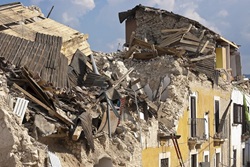
Four previous incarnations of the building have been jackhammered into the ground by Israeli forces, but a demolition ordered last September by the Israeli forces has not yet happened.

The peace center was resurrected from the rubble of the family house of Salim and Arabiya Shawamreh. The project was funded largely by 400 United Methodist churches in Minnesota, built by an international coalition of volunteers and supported by hopes that the Israeli government's policies about Palestinian home demolition may be changing.

The repeated demolition of their home has been hard on the Shawamrehs and their seven children.

"One of my sons dreams of soldiers and demolitions," Salim said. "My oldest son left school at 16. My daughter who is 15 is very afraid. They wonder, 'How can you protect me when you can't stop them from tearing down our house?'"

The most recent demolition order unleashed a flurry of phone calls, letters and personal visits to U.S. leaders in an effort to bring international pressure on the Israeli policy. That persuasion stayed the bulldozers when nothing had before.

In 1990, the Shawamrehs, a Palestinian couple, bought the land where the center now stands. Both were raised in refugee camps, and a home of their own was a lifelong dream. Despite having full rights to the land, the Shawamrehs were twice denied building permits by the Israeli government. Finally, the couple decided to build in 1993, despite not having the permit.

A demolition order was issued a year later, and that house was torn down in 1998 as the family sat down to lunch. The Shawamrehs enlisted the help of the Israeli Committee Against Home Demolitions and became the first family to rebuild their house.

The build-and-demolish scenario was repeated three more times during the next five years. In one instance, the family had 15 minutes to get out. Two other times, the house was torn down the day after it was completed.

After the final demolition, the Shawamrehs leased their land to ICHAD and other groups to rebuild their home as a peace center. The idea was to build a center to tell the stories of the demolitions, a symbol of nonviolent resistance to Israel's policy of demolishing Palestinian homes.

Activists say the Shawamrehs' experience "illustrates the political agenda of the demolition policy, as well as the trauma and suffering caused by such a policy."

The Israeli government says it issues demolition orders for houses that are constructed without building permits or are in the way of planned development.

Aviv Ezra, deputy counsel general of the Consulate General in Atlanta, part of the Israel Diplomatic Network, said the Israeli government has a policy of house demolition in the West Bank "if we feel it will stop a 'ticking bomb,' a terrorist who is about to commit murder-suicide and kill innocent civilians. We will also take down houses after a suicide-murder of the dispatcher or family members as a deterrence to further violence."

Asked about the Shawamreh home in particular, he said that if the house was in legal dispute he could not comment on the specifics of the case.

After the last demolition order was issued for the Shawamrehs' home, a wide network of supporters, including United Methodists, used phone calls, letters and personal persuasion to key U.S. political leaders to bring pressure on Israeli officials. So far, it's been effective.

The Shawamrehs visited the United States last fall, and Salim recalled the trip fondly. "In Minnesota, we met many kind people," he said. "Many of them are supporting us, talking to their senators. It's given me a lot of hope. And they promised us that if the Israelis demolished our home again, they will come help us rebuild it."

In 2003, the Minnesota United Methodist Annual (regional) Conference voted to donate a majority of its annual love offering to the rebuilding project, earmarking more than $60,000 for the peace center. That donation spurred the family to go ahead and rebuild the Shawamreh home, this time as a home base for education efforts to stop the bulldozing.

The center is dedicated to the memory of two women killed in 2003 during house demolitions: Rachel Corrie, an American volunteer, and Nuha Sweidan, a pregnant Palestinian woman who died when the wall of a neighboring home being demolished fell on her.

Longstanding policy

The Israeli policy of bulldozing homes has been going on since the start of Israel's occupation of the West Bank in 1967. About 10,000 Palestinian homes have been demolished since then, with the demolition policy escalating in the last two years. Activists say that, currently, between 75 and 100 homes are torn down every month.

The Israeli government often cites expansion needs as a reason for demolitions, in addition to tearing down homes that have not been issued permits through the murky bureaucratic system. Only about 5 percent of demolitions involve the homes of suspected terrorists and their extended families, according to activists.

But Ezra, the Israeli deputy counsel general, disputed the claim that about 5 percent of the homes that are demolished are terrorist-connected. On the contrary, he said, "most of the homes" that are torn down are terrorist-related.

Salim and Arabiya have decided they will not return to live in their home until they have been issued a building permit. The family now lives nearby in an apartment. The process is slow and progress sometimes impossible to measure.

The effort to halt the demolition policy has support within Israel and the United States. Spearheading efforts is the Israeli Committee Against House Demolitions, led by former Minnesotan Jeff Halper, and the Palestinian Land Defense Committee.

These groups began rebuilding homes - like the Shawamrehs' - that had been demolished for lack of a building permit. Eighteen homes and a kindergarten have been rebuilt through this effort.

Another organization, Rebuilding Homes, was formed in June 2002 as a partnership of Israeli, Palestinian and American groups. The group's goal is to raise awareness and funds to "rebuild Palestinian homes and Middle East peace through strategic Palestinian and Israeli cooperation."

Working for change

The Minnesota Conference has been active in the area since 1947, when Methodists helped set up tents for displaced Palestinians. Now the focus is on education and working to bring both sides of the situation to light in hopes of an eventual peace in the region.

The Rev. Dwight Haberman, a retired pastor, just returned from a trip to the troubled region and found the effect of the house demolition policy is widespread.

"The numbers are stunning, and it's so hard for the families, especially the women," he said. "Home is everything to them. This is just so tragic."

The Rev. Lyle Christianson, another retired Minnesota pastor who has been to the region seven times in the past 30 years, echoed Haberman's thoughts.

"The general feeling that people have is that the Palestinians are the cause of all the trouble, all the acts of terrorism, in the Middle East," he said. "We are trying to show the other side of the story."

On his trips, he said, he has found that there is support from Jews and Israelis to stop the demolitions. He recalled a Palestinian shop owner's description that "my Jewish neighbors are wonderful but the Israeli government is cruel."

He expects the work to continue. "We've established a prayer program in each of our 400 churches. Each church is asked to spend 24 hours in prayer and have a program about the issue," he explained. "It hasn't been perfect, but it's improved their understanding."

*Read is a freelance journalist based in Nashville, Tenn.   News media can contact Linda Bloom at (646) 369-3759 or newsdesk@umcom.org.

Ask Now

This will not reach a local church, district or conference office. InfoServ* staff will answer your question, or direct it to someone who can provide information and/or resources.

First Name:*
Last Name:*
Email:*
ZIP/Postal Code:*
Question:*

*InfoServ ( about ) is a service of United Methodist Communications located in Nashville, Tennessee, USA. 1-800-251-8140

Not receiving a reply?
Your Spam Blocker might not recognize our email address. Add this address to your list of approved senders.

Would you like to ask any questions about this story?ASK US NOW


Contact Us

This will not reach a local church, district or conference office. InfoServ* staff will answer your question, or direct it to someone who can provide information and/or resources.

Phone
(optional)

*InfoServ ( about ) is a ministry of United Methodist Communications located in Nashville, Tennessee, USA. 1-800-251-8140

Not receiving a reply?
Your Spam Blocker might not recognize our email address. Add InfoServ@umcom.org to your list of approved senders.